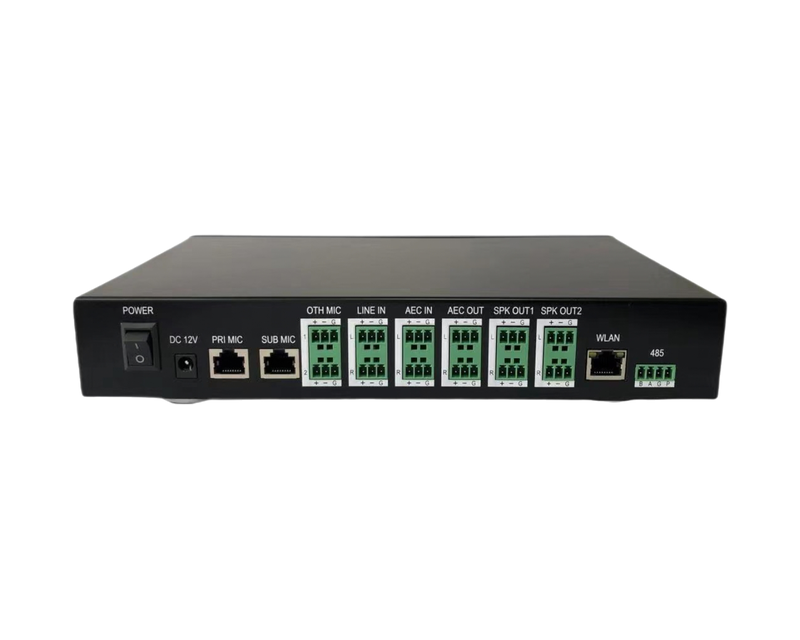
Reach Zone DSP TAP800 is the audio processor at the centre of a teaching sound-reinforcement system. It mixes the teacher microphone, the student microphones and the classroom PC, feeds the local speakers, and keeps the remote class connected through a dedicated echo-cancellation path.
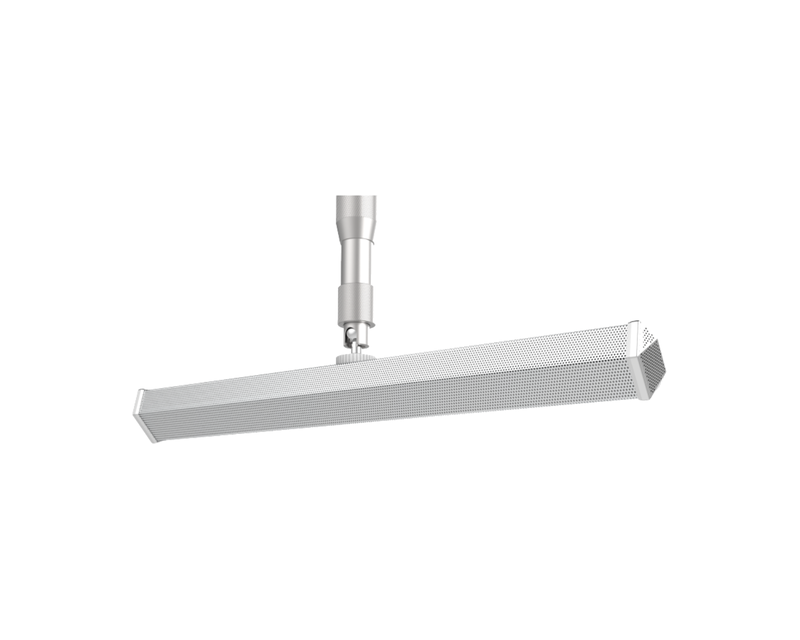
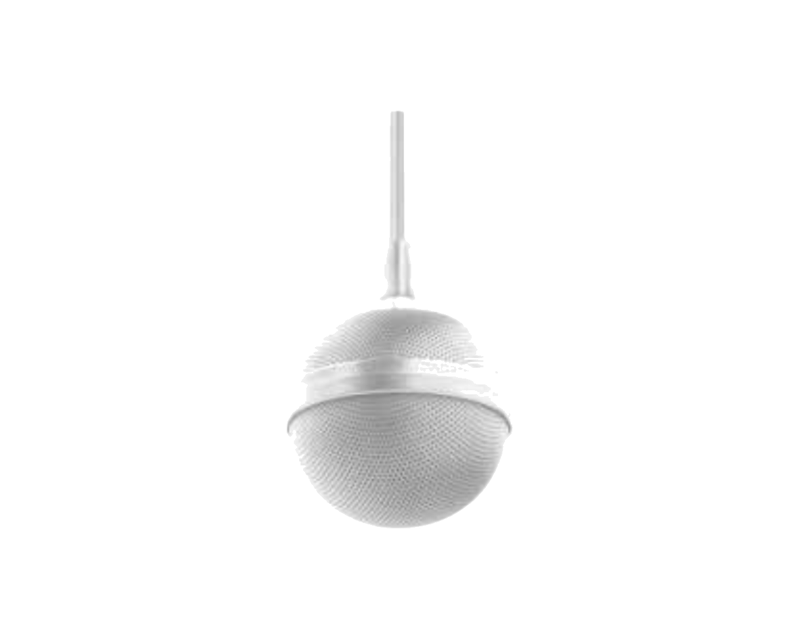
The system has three parts: the TAP800 host, a ACM600 bar array for the teaching area and one or more ACM100 spherical microphones for the student area. The bar array picks up a 180° fan in front of the lectern; the spherical units pick up 360° from a 2.1–2.5 m hanging height. Both were designed for the same processor, so gain, echo cancellation and feedback suppression are set up once, in one place.
The processing is deliberately strong: feedback suppression ≥18 dB, noise reduction ≥30 dB, echo cancellation ≥90 dB over a ≥1 s tail and maximum gain ≥30 dB. That is what lets a teacher walk the platform at normal speaking volume without the room ringing, while the remote site hears a clean signal.
Every input has its own level control on the front panel — other microphones, AEC in, speaker out and AEC out — so a technician can balance the room without a laptop. The rear panel adds phantom power for condenser microphones, a wireless input, an RS485 port for central control and a WLAN port for configuration.
The TAP800 is a half-rack, 270 × 163 × 52 mm chassis. The rear panel carries the power switch and DC input, the microphone inputs, echo-cancellation in/out, the two speaker outputs, the network port and RS485.
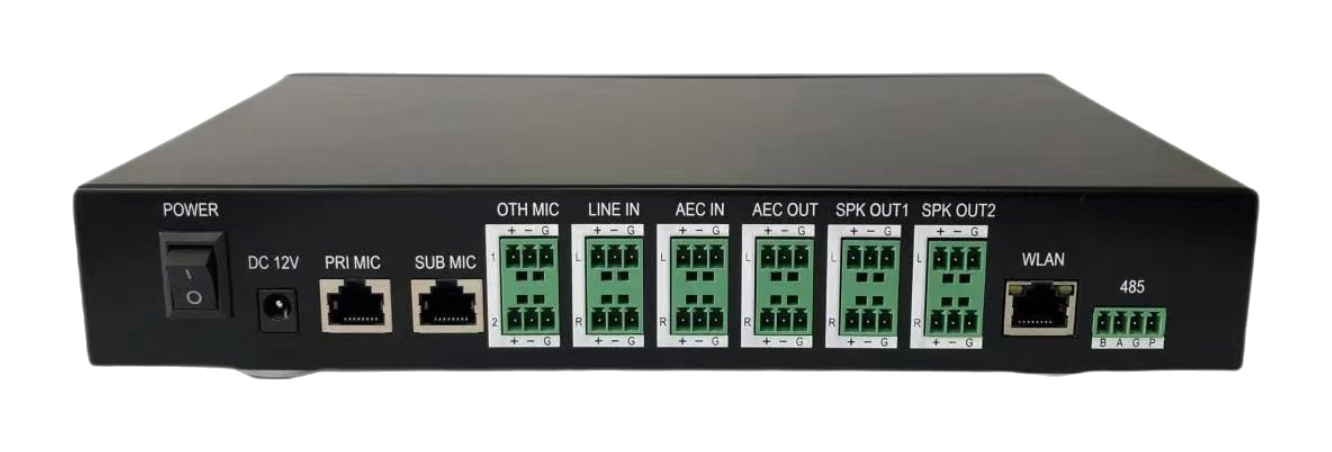
Rear panel — POWER, DC 12V, PRI / SUB / OTH MIC, LINE IN, AEC IN / OUT, SPK OUT 1–2, WLAN and 485.
| Item | TAP800 |
|---|---|
| Sampling rate | 48 kHz |
| Frequency response | 100 Hz – 20 kHz, ±0.3 dB |
| Distortion | ≤0.1% |
| Signal-to-noise ratio | >100 dB |
| Input impedance (balanced) | 20 kΩ |
| Output impedance (balanced) | 200 Ω |
| Maximum input level (balanced) | 4 dBu |
| Maximum output level (balanced) | 10 dBu |
| Input gain adjustment | 64 dB |
| Output gain adjustment | 64 dB |
| Phantom power | 48 V |
| Central control | RS485 |
| Power consumption | 6 W |
| Working voltage | DC 12 V |
| Operating temperature | -10 °C – 50 °C |
| Dimensions | 270 × 163 × 52 mm |
| Function | Value |
|---|---|
| Automatic feedback suppression (AFC) | Supported, ≥18 dB |
| Automatic echo cancellation (AEC) | Supported, ≥90 dB, tail ≥1 s |
| Automatic noise suppression (ANC) | Supported, ≥30 dB |
| Automatic gain control (AGC) | Supported |
| Reverberation suppression (ARR) | Supported, ≥18 dB |
| Maximum gain | ≥30 dB |
| Connector | Function |
|---|---|
| POWER | Power switch |
| DC-12V | Power input, DC 12 V / 2 A |
| PRI MIC | Master microphone input |
| SUB MIC | Slave microphone input |
| OTH MIC | Other microphone input — phantom-powered or wireless, selected in the PC software |
| LINE IN | External audio input, typically the classroom PC |
| AEC IN | Far-end reference signal input for the interactive session |
| AEC OUT | Far-end signal output to the terminal |
| SPK OUT 1 / 2 | Local speaker output 1 and 2 |
| WLAN | Network port |
| 485 | RS485 interface, with a reserved one-button mute input |
The ACM600 sits in front of the teacher, either on the lectern or on a short suspension. It uses six condenser capsules in a bar with a 180° fan-shaped pickup pattern and reaches 8 m, which covers the whole teaching area without a body-worn microphone. Two Category 5e/6 cables connect it to the TAP800.
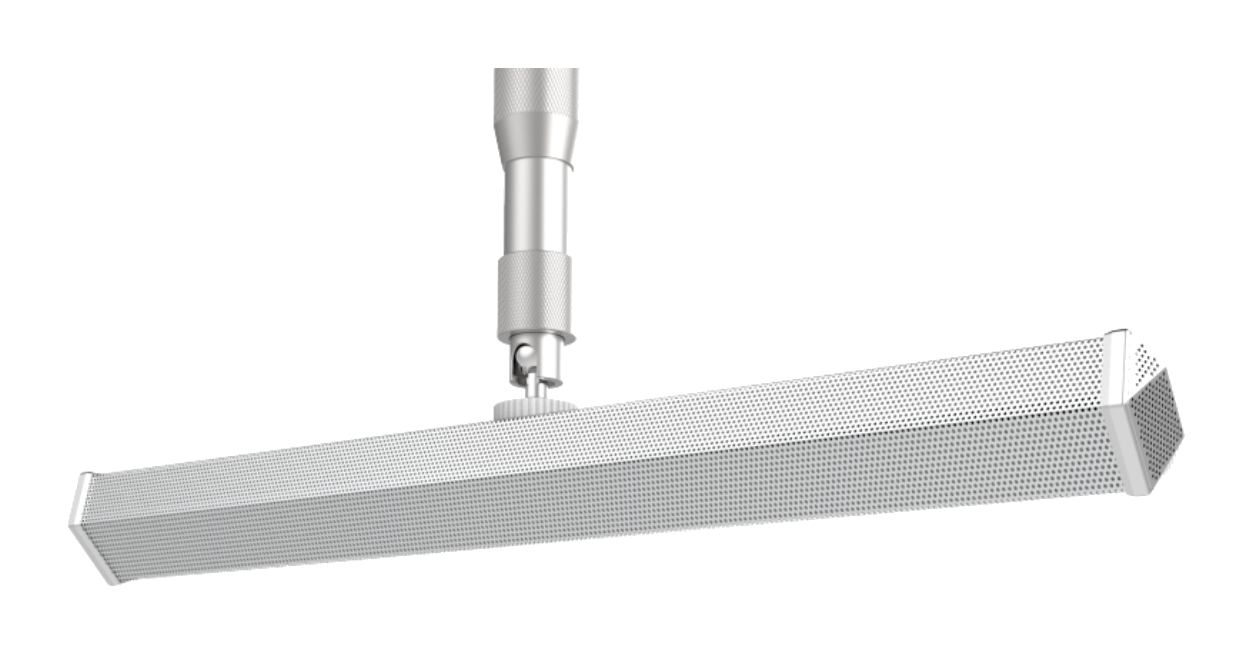
ACM600 — bar array, 180° fan pickup, 8 m range.
| Item | ACM600 |
|---|---|
| Capsules | 6 condenser capsules |
| Pickup pattern | 180° fan-shaped |
| Pickup distance | 8 m |
| Sensitivity | -37 ± 3 dB |
| Frequency response | 100 Hz – 20 kHz |
| Signal-to-noise ratio | 70 dB |
| Connector | RJ45 × 2, Cat 5e / Cat 6 |
| Working voltage | DC 12 V |
| Operating temperature | -10 °C – 51 °C |
| Dimensions | 446 × 49.3 × 45.7 mm |
The ACM100 hangs over the student area at 2.1–2.5 m and picks up 360° around itself, so a student speaking from any seat is heard. A single capsule with a noise-suppression circuit and phantom power over XLR keeps the installation simple: one shielded two-core cable per unit.
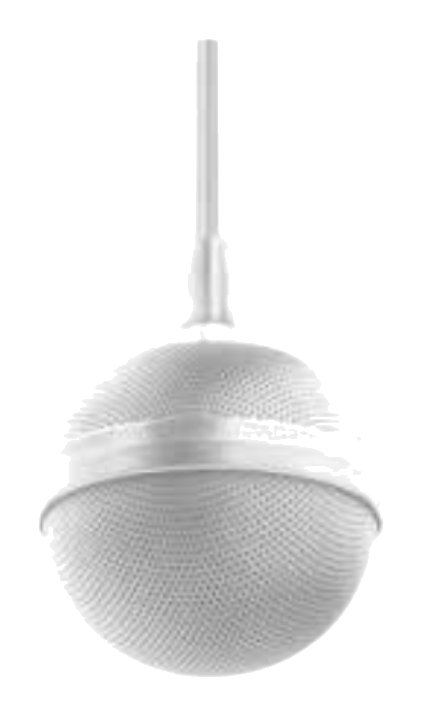
ACM100 — spherical, 360° omnidirectional, suspended.
| Item | ACM100 |
|---|---|
| Capsules | 1 condenser capsule |
| Pickup pattern | 360° omnidirectional |
| Pickup distance | 8 m |
| Sensitivity | -25 ± 3 dB |
| Frequency response | 100 Hz – 20 kHz |
| Signal-to-noise ratio | 78 dB |
| Connector | XLR |
| Working voltage | Phantom 48 V |
| Operating temperature | -10 °C – 52 °C |
| Dimensions | Φ70.6 mm |
Installation note: keep the vertical distance between the speaker and the front of the ACM600 bar above 30 cm, and hang the ACM100 units 2.1–2.5 m above the floor, clear of the loudspeakers.
 Tel:+86 18589023158