

Charles Sturt University, Bathurst-Education

Home > Case> Education Contact

Charles Sturt University, Bathurst

source: Reach Tech popularity:2727 Time of publication:2021/04/13 16:06:36 【 small middle big】
InstitutionCharles Sturt University — School of Biomedical Sciences
LocationBathurst, NSW, Australia
Scope12 teaching spaces in a A$2.8 million centre
SolutionREACH recording and streaming, controlled by AMX

Three operators, twelve teaching spaces, three clinical simulations running at the same time.
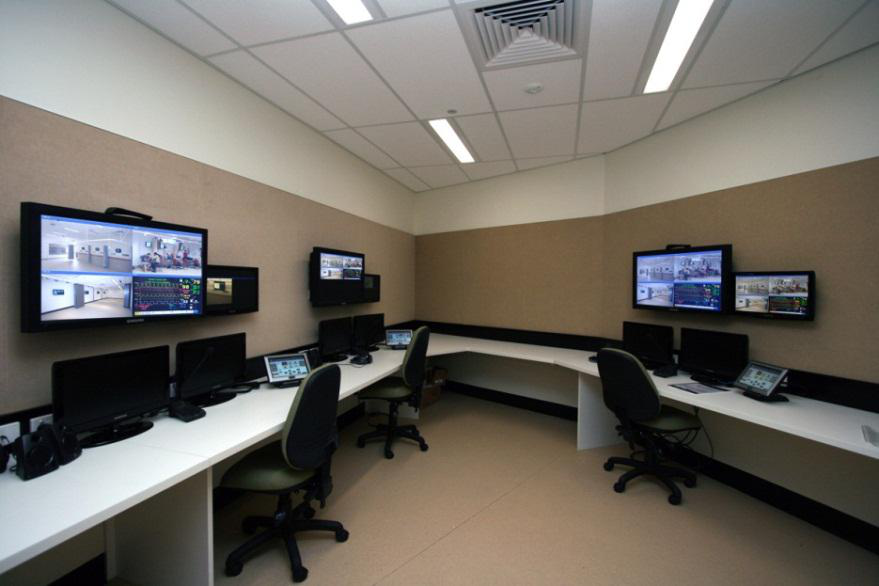
Control room at the Charles Sturt University clinical simulation centre
Three operator desks face a virtual video wall; each desk runs one simulation.

The challenge

Charles Sturt University trains nurses and paramedics for inland Australia, where the nearest specialist is often hours away, and its teaching has always leaned on practice rather than lecture theatres. The Bathurst clinical simulation centre was built to make that literal: scenario rooms that can be dressed as a ward, a theatre or an emergency bay, plus breakout rooms for briefing and debriefing. The centre needed the simulations recorded in broadcast-quality detail so that students could be assessed on what they actually did, and it needed several scenarios to run at once without an operator standing in every room.

What Reach deployed

A server-based REACH recording and streaming system sits behind HD pan-tilt-zoom cameras, ceiling microphones, wall displays and ceiling projectors spread across the scenario, breakout and teaching spaces. Control is handed to an AMX touch panel that draws the building as a map: each area is a zone, and an operator builds a session by selecting the zones for the scenario in front of them. The large display at each desk behaves as a virtual video wall, showing up to six live images at once — the room cameras plus the SimMan diagnostic feed — and the operator chooses which of those images are recorded or streamed. The system was delivered with All AV, an authorised Reach partner and the university's preferred AV integrator.
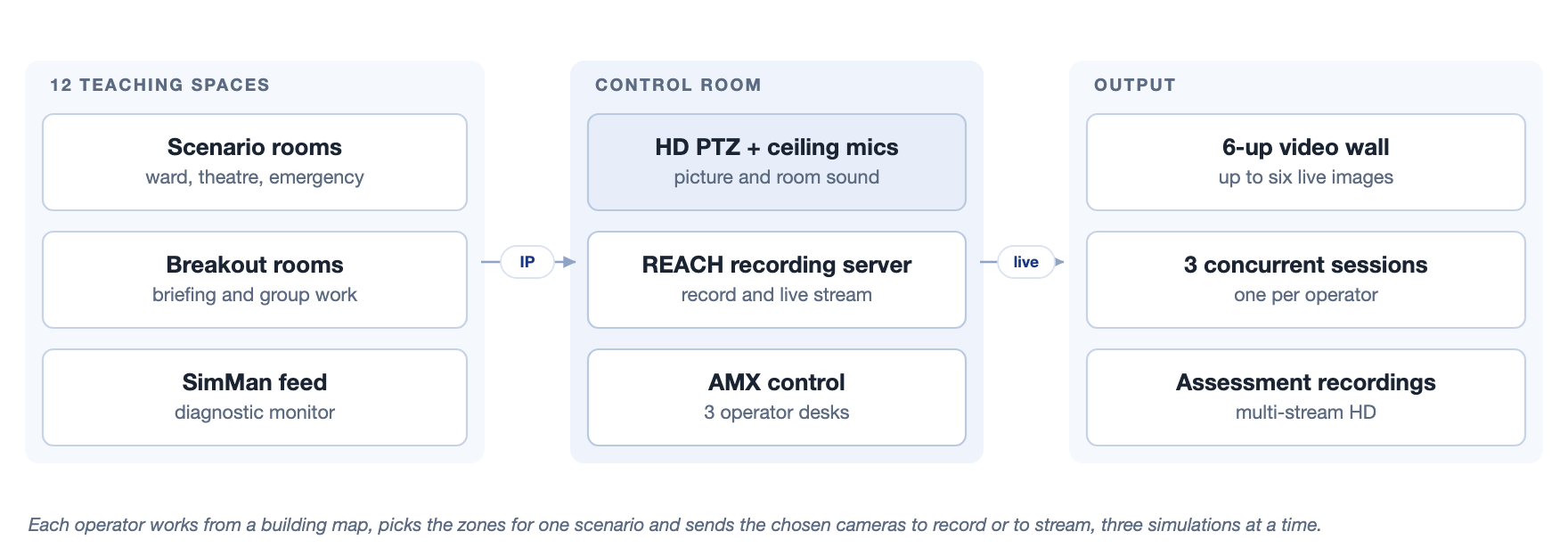

Charles Sturt University simulation centre architecture
Figure 1 — Twelve spaces are grouped into zones; three operator desks record and stream three scenarios at once.

How it works

  1. An operator selects zones on the building map — for example a scenario room, its breakout room and the adjoining ward.
  2. The desk shows up to six live images, including the patient monitor, so the operator can follow the scenario without entering the room.
  3. Chosen images are recorded and streamed as a multi-stream session, with room audio attached.
  4. The recording becomes assessment material: students and tutors replay the same session from different angles.

Outcome

  • Twelve teaching areas run from one control room, with three simulations in parallel.
  • Recordings are multi-stream HD, so a debrief can show the procedure, the team and the monitors together.
  • Assessment and feedback use the recording itself rather than a tutor's recollection.
  • The same control layer extends to further rooms as the centre grows.