

The same recorders turn up in a consumer-goods boardroom, a Harvard teaching hospital and a university psychology lab.
Reach recorders reached the United States through authorised partners — DNR Pro, DGI, HB Communications, AVR, RnB Enterprises and Veraview — and the pattern of use says more about the product than any single site does. In each case the requirement was the same: capture several sources in a room, stream them, keep the recording, and do it without adding staff.
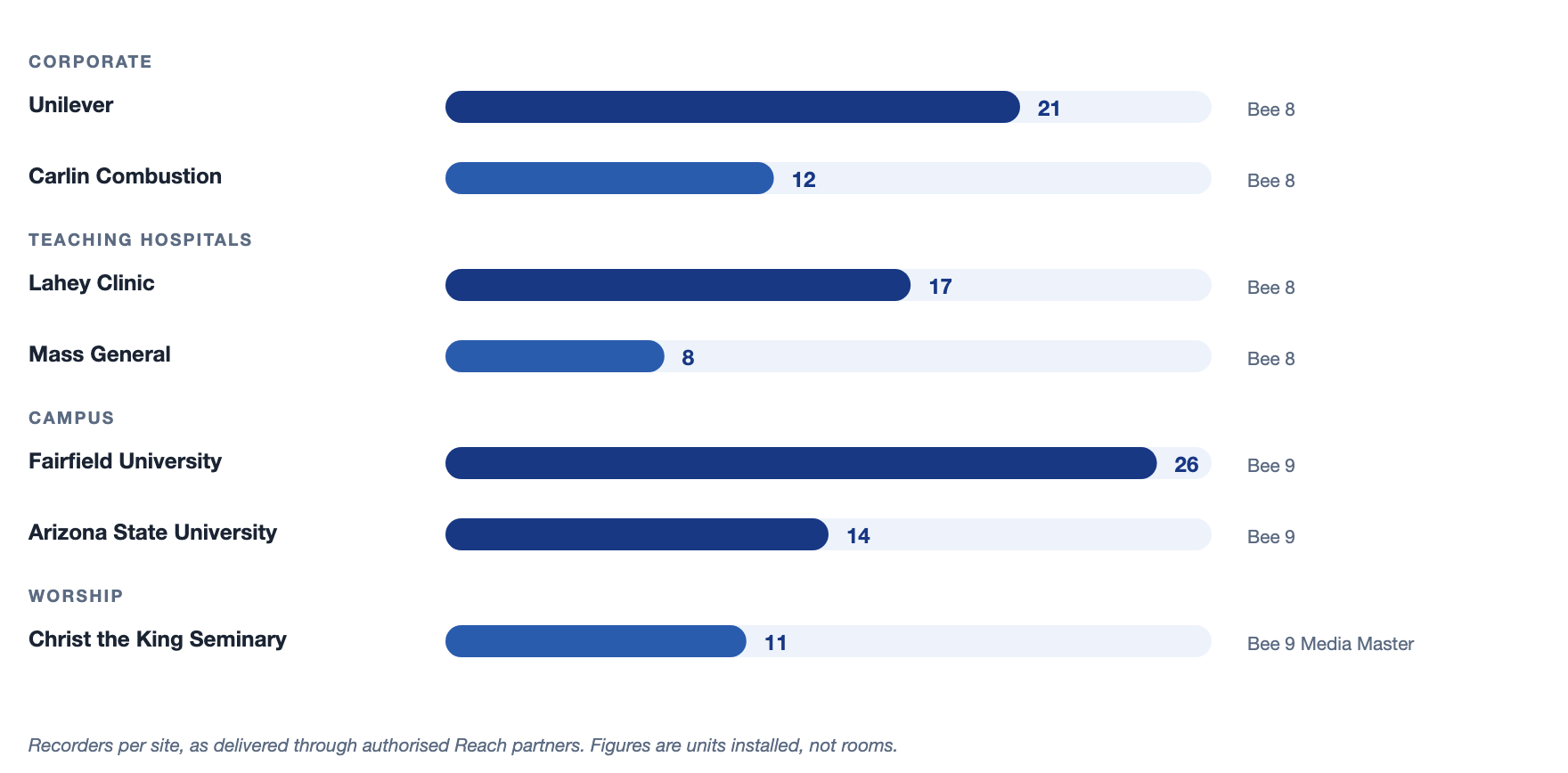
Unilever, the company behind Dove, Lipton and Ben & Jerry's, took 21 Bee 8 recorders for conference rooms, training rooms and product assessment panels. Carlin Combustion Technology took 12 for its conference and product-training rooms. In both companies the recorder is invisible: a room either records or it does not, and the meeting continues either way.
Lahey Clinic, a teaching hospital of Tufts University School of Medicine, replaced an Accordent system with 17 Bee 8 recorders and Media Center for Grand Rounds in its main auditorium, where collaborating doctors join from as far away as Jordan. The hospital also printed QR codes on the backs of the last two rows of chairs and beside the doorways, so a phone can pick up the third input and share the session. Massachusetts General Hospital, the teaching hospital of Harvard Medical School, uses 8 Bee 8 recorders in its simulation and training group, whose learning laboratory in the Treadwell Library is shared across a network of affiliated simulation labs.
Arizona State University installed 14 Bee 9 recorders in its large auditoriums as a redundant backup to an existing lecture-capture platform, so a failure in one system does not lose a lecture. Fairfield University put 26 Bee 9 recorders into the interview rooms of its psychology department, one camera per room — the smallest possible installation, repeated at scale.
Christ the King Seminary, chartered by the Education Department of the State University of New York, records with 11 Bee 9 Media Master units, each with four HD inputs.
 Tel:+86 18589023158